
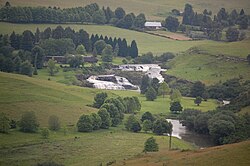
The Department of Water and Sanitation has moved against JB Marks Local Municipality after years of complaints about raw sewage flowing from Ikageng into the Mooi River, a source of water for homes, farms and industry in the North West.
On Friday 16 January 2026, Deputy Minister of Water and Sanitation Sello Seitlholo met officials of JB Marks Local Municipality in the North West to confront a problem residents and environmental groups have been reporting for years: sewage overflowing from the sewer network in Ikageng, the township beside Potchefstroom, and flowing into the Mooi River. The department has issued a notice of its intention to direct the municipality to stop the pollution under the National Water Act, after concluding that the municipality’s earlier responses had not solved the problem.
It is a familiar story in South Africa, and an important one. The Mooi River is not a minor stream. It supports domestic water supply, agriculture, livestock and industry, and it is part of the wider Vaal River system on which millions of people depend.
Manholes that never stop overflowing
According to the department, ageing and failing sewer infrastructure in Ikageng has led to manholes overflowing and spilling with alarming frequency. The untreated sewage reaches the Mooi River either directly or through stormwater channels, which were designed to carry rainwater, not waste.
The complaints are not new. Between 2020 and 2023, residents and organisations lodged complaints with both the Department of Water and Sanitation and the Department of Forestry, Fisheries and the Environment. A criminal case opened by civil society is under investigation by an environmental management inspector from the environment department. Yet the department says complaints have continued to arrive, a sign that the problems in the sewer network and pump stations have not been fixed.
During the site inspection, officials heard from residents of Extension 7, near Poortjies Dam, where two households have reportedly lived with sewage spills for about ten years. Imagine a decade of raw sewage around your home, and the scale of the institutional failure becomes clear.
A municipality without the tools
Seitlholo was direct about one of the causes. He said the municipality does not have the equipment needed to respond quickly and effectively to sewage spills. The municipality has unblocked some manholes affecting businesses, but without suitable machinery, such as jet-vacuum trucks and spare pumps, it cannot keep up with the blockages and failures that a deteriorating network produces every day. He described the situation as unacceptable and said it could not be allowed to continue, and he raised the issues with the municipal manager and the councillor acting as mayor.
This is a pattern repeated across the country. In December, the Auditor-General reported that municipal water services authorities spend on average only 3 percent of the value of their infrastructure on maintenance, far below the 8 percent benchmark, and that almost all of them fail to meet maintenance norms. When a municipality cannot afford or does not prioritise basic maintenance equipment, sewer blockages turn into permanent spills.
What the department is doing
The department’s main tool is a directive under section 19 of the National Water Act, which deals with the prevention and remedying of pollution. If a person or institution responsible for pollution fails to take the steps required by a directive, the department can carry out the work itself and recover the costs. The notice of intention is the formal step before a directive is issued, giving the municipality a chance to respond.
Alongside enforcement, the department has approved several projects under the Water Services Infrastructure Grant to rehabilitate and upgrade sewer infrastructure in Promosa and Mohadin, two other areas of the municipality. A follow-up meeting was scheduled within two weeks to assess whether the municipality had begun corrective work.
Why the Mooi River matters
The Mooi River rises in the North West and flows past Potchefstroom before joining the Vaal. Along the way it feeds dams that supply water for the town and for irrigation. Any pollution entering it does not stay local. It adds to the load carried by the Vaal, which already receives sewage from failing works upstream, including the long-troubled systems of Emfuleni in Gauteng.
The river also matters to Potchefstroom’s identity. The town is home to North-West University, whose scientists have done extensive work on water quality and pollution in South African rivers. Communities, farmers and researchers have been warning about the river’s health for years.
Enforcement that comes too late
The intervention is welcome, but it also illustrates a weakness in the system. Complaints were lodged as early as 2020. A criminal case was opened. Households lived with sewage for a decade. Only now is the department moving towards a formal directive. Environmental law in South Africa is strong on paper, but enforcement against municipalities is slow, partly because one arm of the state is reluctant to sue or prosecute another, and partly because fines paid by a municipality ultimately come out of the same public purse.
That is why the outcome in JB Marks will be worth watching. If the directive leads to rapid repairs, new equipment and a measurable drop in spills, it could become a model for how the department uses its regulatory powers. If it becomes another round of meetings and progress reports, the Mooi River will keep paying the price. For residents of Ikageng, and for everyone downstream, the test is simple: whether the manholes stop overflowing.
References
SAnews: Government intervenes over sewer crisis in JB Marks Municipality (19 January 2026): https://www.sanews.gov.za/node/79167
AllAfrica: Government intervenes over sewer crisis in JB Marks Municipality (19 January 2026): https://allafrica.com/stories/202601190162.html
Parliamentary Monitoring Group: Water Sector Report, AGSA briefing (2 December 2025): https://pmg.org.za/committee-meeting/42181/
Department of Water and Sanitation: National Water Act, 1998: https://www.dws.gov.za/Documents/Legislature/nw_act/NWA.pdf
SAnews: Progress made to improve North West water infrastructure: https://www.sanews.gov.za/node/80492