
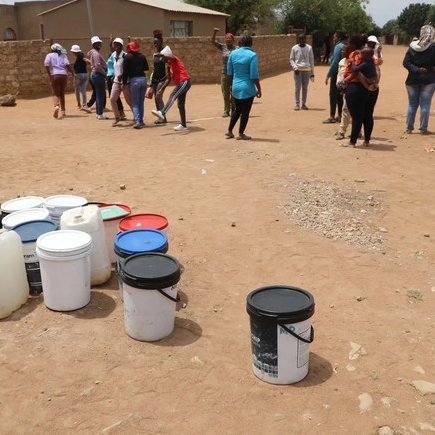
The Bronkhorstspruit treatment works ran without disinfection for 21 days, and nearly 600 people, many of them small children, fell ill. Parliament has now heard that water in parts of central Pretoria was also not being disinfected.
For 21 days, from 23 or 24 September to 14 October 2026, the Bronkhorstspruit water treatment works in the east of the City of Tshwane supplied water to residents without chlorinating it. Chlorine is the final barrier that kills bacteria and viruses before water reaches the tap. Without it, water drawn from a river that is heavily polluted with sewage flowed straight into homes in Bronkhorstspruit, Zithobeni, Dark City, Rethabiseng and Sokhulumi. Residents were not warned.
The consequences were swift. Between 7 and 19 October, 595 cases of acute gastrointestinal illness were recorded in the area, including 262 children under the age of five. No deaths have been reported. This week, Parliament heard that the problem may not be limited to Bronkhorstspruit.
What happened
According to the Department of Water and Sanitation, problems with Tshwane’s chlorine supply meant that unchlorinated water was released from the Bronkhorstspruit works. The department’s tests on 14 October found very high levels of E. coli and total coliform bacteria in water from the plant and from the Ekandustria and Zithobeni reservoirs. The city closed the plant that day, restored chlorine supply on 15 October and reopened it on 16 October, but warned that the water was still not safe.
The National Institute for Communicable Diseases found norovirus, campylobacter and shigella in stool samples from patients, and later also sapovirus. No cholera was detected. Minister Pemmy Majodina said the presence of these pathogens and the rapid spread of illness pointed to a common water supply.
Most seriously, investigations found that the city did not warn residents that their water had not been chlorinated. Mayor Nasiphi Moya said the city became aware of a rise in diarrhoea cases around 7 October, and acknowledged that its usual communication channels, including WhatsApp, social media and ward councillors, may not have reached everyone. She also said that the city’s leadership had not been informed of the chlorine problem in time.
Why the chlorine ran out
The city has blamed a dispute with its chlorine supplier. According to Moya, the supplier sought a price increase of around 400 percent in the middle of its contract, far beyond the adjustments the city says the law allows, and the city could not afford it. Officials briefing Parliament gave a different figure, a 40 percent increase, and the discrepancy has not been explained. Rand Water has said that problems with Tshwane’s chemical supply contracts threaten uninterrupted supply. The city had been buying chlorine through quotations and has approved a replacement tender, as its current contract ends in December.
Whatever the precise figure, the outcome points to a basic failure of contingency planning. A water treatment works cannot be allowed to run out of disinfectant for three weeks without an alternative supplier, an emergency procurement process or, at the very least, an immediate public warning.
Not just Bronkhorstspruit
On Friday 23 October, senior officials from the Department of Water and Sanitation, including Deputy Minister David Mahlobo, Director-General Sean Phillips and compliance head Anet Muir, briefed Parliament’s health committee alongside Health Minister Aaron Motsoaledi. They told MPs that an inspection on 21 October had found that water in the Findlay reservoir, supplied by the Fountains water treatment works and serving the Pretoria city centre, was not being disinfected, and that E. coli levels there exceeded the national standard. The department described the water as unsafe for human consumption, and residents and businesses in the Pretoria CBD and surrounding areas were advised to boil tap water until further notice.
The department also revealed that it had issued a formal regulatory letter to Tshwane in February 2026, and that the city’s corrective action plan, submitted in March, was not implemented on time. It is now investigating chlorination across the whole metro. Advice for the CBD has been changing as tests are completed, so residents should follow the city’s latest official notices.
Upstream pollution
The crisis is also a story about pollution. The Bronkhorstspruit works draws water from the Bronkhorstspruit River, which receives effluent from upstream sewage works, including the Delmas and Botleng works in Mpumalanga’s Victor Khanye municipality, and from non-operational sewage pump stations in Tshwane. A criminal case over the Delmas plant opened in 2020 is still with the National Prosecuting Authority. The more polluted the source water, the more vital chlorination becomes. The Bronkhorstspruit works itself scored only 42 percent in the 2023 Blue Drop assessment.
Accountability
The Department of Water and Sanitation opened a criminal case against the city on 18 October for failing to provide required information or providing misleading information, and is discussing further charges with the National Prosecuting Authority. The DA in Tshwane has also opened a criminal case. The department has welcomed a Public Protector investigation and is engaging the Human Rights Commission.
Moya has called the chlorine shortage indefensible and preventable, accepted overall political responsibility and said that political accountability must be matched by administrative accountability. A plant manager has been suspended and independent investigations are under way. She has also said she hopes the crisis was not the result of political sabotage, while saying she will contest the charges in court. Phillips told Parliament that years of underinvestment had created a downward spiral, and that ring-fencing water revenue for maintenance is essential. He noted that the department has no legislative power to take over the plant directly.
What residents should do
In Bronkhorstspruit and surrounding areas, tap water should be used only for flushing toilets until the city confirms it is safe, even if it is boiled. Safe drinking water is being supplied by a fleet of 36 tankers from tested sources in Cullinan and Rayton. Stored tap water should be discarded and containers disinfected with household bleach. Anyone with symptoms such as diarrhoea, vomiting or stomach cramps, especially young children, should seek medical care early. Rand Water is being brought in to repair the Bronkhorstspruit plant, and no date has yet been given for when the tap water will be safe.
A warning for the whole country
For the MAP Forum, this crisis is close to home. Tshwane is where our organisation began, and the city’s rivers, from the Moreleta to the Apies and Pienaars, have featured in our reporting all year. The Bronkhorstspruit outbreak shows what happens when the final safeguard fails in a system already under strain. Polluted rivers, weak procurement, ignored regulatory warnings and poor communication combined to put hundreds of children in hospital.
The lesson is not only for Tshwane. Every municipality that treats water from a polluted river is one missed chlorine delivery away from the same outcome. Ensuring that disinfection never stops, and that residents are told immediately when it does, must be a non-negotiable duty of every water service provider in the country.
References
GroundUp: Tshwane water is unsafe for human consumption, Parliament hears (24 October 2026): https://groundup.org.za/article/tshwane-water-is-unsafe-for-human-consumption-parliament-hears/
SAnews: Coordinated response launched to tackle Bronkhorstspruit water illness surge (19 October 2026): https://www.sanews.gov.za/node/85072
TimesLIVE: Bronkhorstspruit crisis, Tshwane failed to warn residents over unsafe water (19 October 2026): https://www.timeslive.co.za/news/south-africa/2026-10-19-bronkhorstspruit-crisis-tshwane-failed-to-warn-residents-over-unsafe-water/
EWN: Tshwane mayor hopes Bronkhorstspruit water crisis isn’t political sabotage as city faces criminal charges (20 October 2026): https://www.ewn.co.za/2026/10/20/tshwane-mayor-hopes-bronkhorstspruit-water-crisis-isn-t-political-sabotage-as-city-faces-criminal-charges
EWN: Bronkhorstspruit residents warned not to consume tap water as Tshwane races to restore supply (21 October 2026): https://www.ewn.co.za/2026/10/21/bronkhorstspruit-residents-warned-not-to-consume-tap-water-as-tshwane-races-to-restore-supply
BusinessTech: Warning to residents living in and around Pretoria (20 October 2026): https://businesstech.co.za/news/?p=880479
eNCA: Bronkhorstspruit water crisis, chlorine supply and costs under scrutiny (21 October 2026): https://www.enca.com/news-top-stories-videos/bronkhorstspruit-water-crisis-chlorine-supply-and-costs-under-scrutiny