
The weather service expects a hot, dry summer from one of the strongest El Niño events on record, and the real test will be the country's pipes, reservoirs and municipal planning rather than its dam levels.
A forecast the country cannot ignore
For most of this year, South Africa’s water story has been about too much water in the wrong places and too little in the taps. Dams filled after good rains, while suburbs in Johannesburg and Tshwane went days without supply. Over the past fortnight, a third element has moved to the front of the conversation: the weather itself is about to turn against us.
The South African Weather Service (SAWS) has been warning since September that a strong El Niño is building in the Pacific Ocean. In a statement carried by SAnews on 1 September, the weather service said the event “could become the strongest event in living memory,” and that sea surface temperatures in the key part of the tropical Pacific were already above the threshold for a very strong event. Its outlook for October to December, and again for November to January, pointed to below-normal rain over most of the country and very likely above-normal temperatures.
The October update raised the alarm further. Daily Maverick reported on 23 October that SAWS had released its monthly Seasonal Climate Watch almost two weeks earlier than usual, and that the forecast for November to March showed an increased likelihood of below-normal rain across large parts of the summer rainfall region. The dry signal stretches across the interior and the northeastern half of the country, which includes the Kruger National Park and important irrigated farming areas. According to the same report, the World Meteorological Organization expects Pacific surface temperatures to rise as much as 3.8°C above average between November and January, far past the 0.5°C mark at which an El Niño is declared.
SAWS itself has been careful to say that not every El Niño brings drought. The 1997/98 event, also very strong, coincided with slightly above-normal rain in parts of the summer rainfall region. But the 1982/83 and 2015/16 events both brought widespread drought, and the weather service warned that if rain does fail, heatwaves are likely to become more frequent and could be severe. The combination of heat and dry weather, the service told Daily Maverick, is “likely to exacerbate water loss” in regions that are already short of water.
Full dams are not the whole story
At first glance the country seems well placed. The Vaal Dam, the backbone of Gauteng’s supply, has been running above full capacity for months. The Citizen reported that the dam stood at between 106.78% and 106.91% from 28 September to 1 October, and rose to 107.3% on 2 October.
Experts and officials have spent October explaining why that is not enough. Daily Maverick’s report noted that high temperatures, evaporation and rising demand can pull dam levels down quickly, and that dry soils reduce how much rain soaks in to recharge groundwater. A full dam buys time, but it does not change how much water a municipality can treat and pump each day, or how much of that water is lost on the way to homes.
The Western Cape offers an early warning of how fast the picture can shift. The Cape Times reported on 26 October that combined storage in the Western Cape Water Supply System was about 74.81% on 5 October, lower than a year earlier and trending downward. Water and Sanitation Minister Pemmy Majodina told Parliament, in reply to questions from Rise Mzansi MP Songezo Zibi, that her department was modelling restriction scenarios for the 2026/27 operating year and that possible El Niño conditions added uncertainty. The City of Cape Town, the paper reported, has already started sending notices to households that used more than 15,000 litres a month for two months in a row.
Gauteng is already stretched
In Gauteng, the problem is not stored water but the system’s ability to move it. The crisis has been building for weeks, as this site reported last week when Rand Water put Johannesburg and Tshwane on notice over their consumption. What has changed since then is the arrival of early summer heat, which pushes demand up just as the bulk supplier is holding the line.
On 29 October, Johannesburg Water issued a statement describing its supply systems as severely constrained. The utility blamed “high demand and excessive draw-off limiting the recovery of reservoirs and towers,” which it said was causing low pressure, intermittent supply and long outages. The affected areas are spread across the city, from the Commando and Central systems to Sandton, Midrand, Soweto and the Deep South. Johannesburg Water said it was reconfiguring the network and throttling supply in targeted areas, and it proposed Level 1 restrictions aimed at cutting demand by about 15%. These include a ban on garden irrigation between 06:00 and 18:00, compulsory spray nozzles on hosepipes, and a ban on hosing down paving or dampening building sand. The utility said Level 2 would be considered if demand keeps rising.
Tshwane is under similar pressure. SAnews reported on 27 October that Executive Mayor Nasiphi Moya had set up a daily evening Water Management Committee and introduced targeted overnight restrictions at 14 reservoirs that still had adequate storage but very high consumption. Moya pointed to “critically depleted reservoir levels, reduced supply from Rand Water and high water consumption” as the causes, with the Garsfontein and Klapperkop reservoirs critically low. This comes on top of the Bronkhorstspruit contamination crisis and continuing water quality concerns in Hammanskraal, which the city is handling at the same time.
The human side of this is visible in the streets. Daily Maverick reported on 30 October that residents of Kensington, Lenasia, Melville and Parktown had protested over water cuts that week, days before the 4 November local government elections, with a combined demonstration planned for 2 November at Johannesburg Water’s offices in Newtown. The report said the Alexander Park Reservoir, which serves 12 suburbs including Kensington, Bez Valley and Malvern, had been on bypass for months because repairs were postponed. Without that storage, the report explained, there is not enough pressure to push water up to higher-lying homes whenever Rand Water restricts bulk supply. Water expert Richard Holden told the publication that “Rand Water cannot physically pump any more water through the system.”
Water lost before it reaches the tap
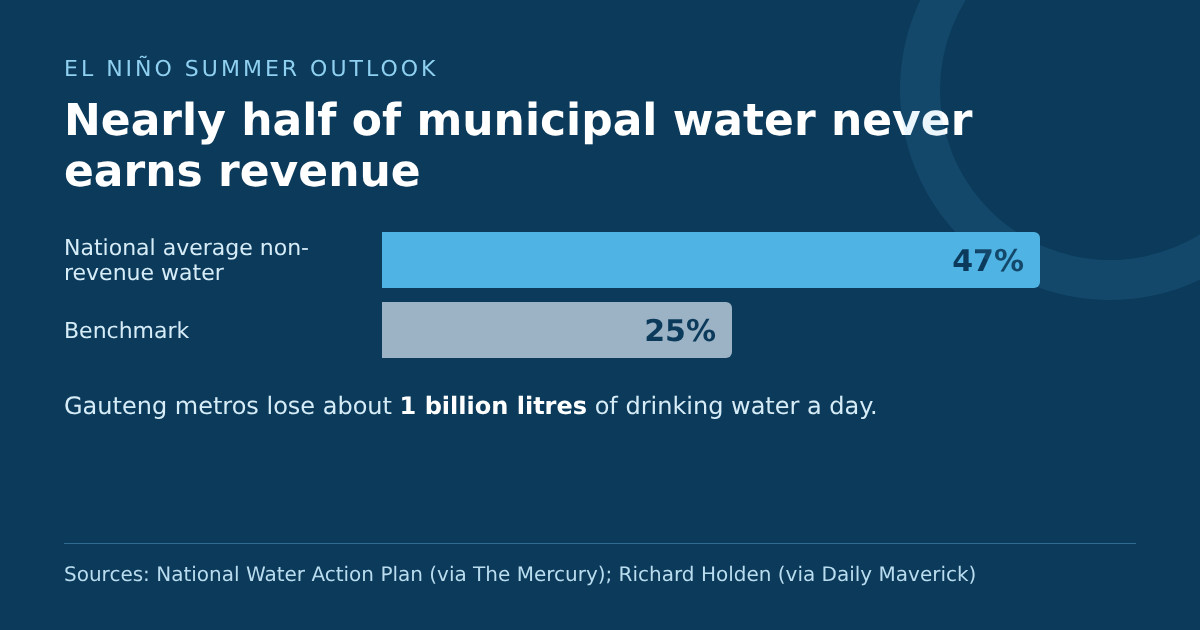
If El Niño delivers a long, hot, dry summer, the single biggest lever South Africa controls is the water it already loses. The numbers are stark. The Mercury reported on 27 October that the National Water Action Plan puts average non-revenue water at 47%, against a benchmark of 25%. Non-revenue water is water that is treated and pumped into the network but never billed, mostly because it leaks out of broken pipes and reservoirs, with some lost to illegal connections and faulty meters. The same plan found that 74% of Water Services Authorities scored poor or critical in drinking water or wastewater assessments, and identified 2,688 communities that are still unserved.
In Johannesburg specifically, Holden told Daily Maverick that around 30% to 35% of treated water entering the city leaks away through degraded pipes and reservoirs, and that Gauteng’s metros together lose about one billion litres of drinking water a day. He described asbestos cement pipes from the early 1940s in Sandton, Randburg and Bedfordview that fail easily, and explained how the sudden return of water after a shutoff can create pressure shocks that break weak pipes further. In other words, the stop and start pattern of supply that heat and throttling produce can make the leaks worse.
The Department of Water and Sanitation has set a 30% non-revenue water benchmark for municipal support, according to the Cape Times, and says municipalities above it are targeted for help. That is a useful marker, but it also shows how far the national average sits from where it needs to be before a drought arrives.
Money on the table, but slow concrete
There is some good news on the funding side. In his Medium-Term Budget Policy Statement on 21 October, Finance Minister Enoch Godongwana said government was increasing the contingency reserve to R10 billion in 2026/27 for drought and El Niño response, along with possible energy price shocks, according to Daily Maverick. The Mercury reported that the minister named El Niño as a risk to the economy and said the National Water Action Plan targets infrastructure and institutional failures, including water losses and weak municipal capacity.
Large new supply schemes are also moving, though none will help this summer. Infrastructure News published a detailed update on 27 October, based on information from the Department of Water and Sanitation, on the country’s mega water projects under construction. The Lesotho Highlands Water Project Phase II, which will add 490 million cubic metres a year to the Integrated Vaal River System that supplies Gauteng, was 56.8% complete against a planned 63.8%. First impoundment of Polihali Dam is targeted for July 2027, with water delivery planned for October 2028. In Limpopo, inside the northeastern zone where SAWS expects the strongest dry signal, the raising of Tzaneen Dam was 66% complete and scheduled to finish in December 2027, adding 36 million cubic metres of storage. The Olifants Management Model, a public private partnership meant to bring bulk water to more than one million people in Sekhukhune, Mogalakwena and eventually Polokwane, had its first stage 14% complete.
These projects matter for the next drought cycle and the one after it. For the summer now beginning, though, the water that reaches homes will depend on existing treatment works, pump stations, reservoirs and pipes, and on how well each municipality manages demand.
What preparedness looks like
The Water Institute of Southern Africa (WISA) has been pressing that point. Its chief executive, Dr Lester Goldman, said in remarks reported by The Mercury: “Climate forecasts are valuable, but their real impact depends on how effectively we use them.” WISA has urged municipalities and water utilities to review their readiness now: check resources against expected demand, find the weak points in their systems, be clear about who responds when risks emerge, and make sure contingency plans can actually be carried out.
The Mercury also reported on a new tool for holding service providers to account. The South African Human Rights Commission and the Claude Leon Chair in Earth Justice and Stewardship at the University of the Witwatersrand have launched a five-year Water Rights Tracker, which will assess progress on the right to water across all 144 Water Services Authorities. That kind of independent monitoring could prove useful if a drought sharpens the gap between municipalities that plan ahead and those that do not.
For residents, the advice from every quarter is the same: use less, fix leaks at home, and follow local restriction notices, which are likely to tighten if the forecast holds.
The weather service has been clear that forecasts deal in probabilities, not certainties, and this summer may turn out kinder than feared. But the 2015/16 drought showed how quickly a dry season can expose a weak system. South Africa enters this El Niño with full dams, a dedicated budget reserve and big projects on the way. It also enters it with close to half of its municipal water unaccounted for and with Gauteng’s two biggest metros already rationing supply. Which of those facts matters more will be decided in the next few months.
References
Daily Maverick: Weather service sounds El Niño alarm for Kruger Park and surrounds (23 October 2026)
SAnews: SAWS warns of very strong El Niño and hotter, drier spring conditions (1 September 2026)
The Mercury: El Niño raises pressure on South Africa's fragile water systems (27 October 2026)
SAnews: Tshwane intensifies water interventions amid supply, quality challenges (27 October 2026)
Cape Times: Cape Town assesses water restrictions as Western Cape dam levels fall (26 October 2026)
The Citizen: Vaal Dam stayed above full capacity this week (2 October 2026)