
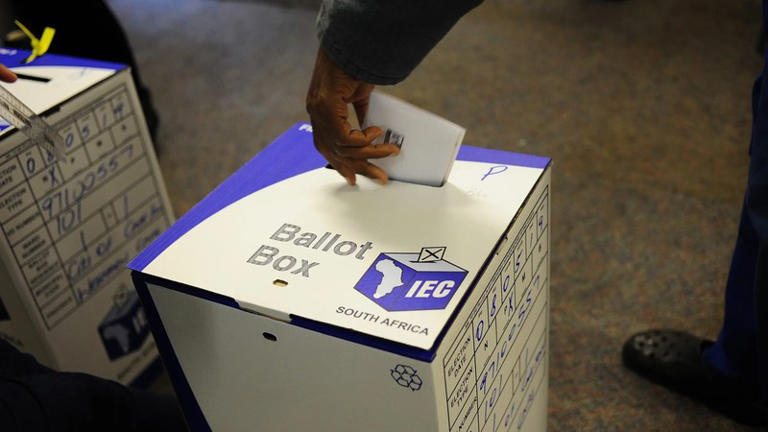
South Africans vote in local government elections on 4 November. After a year of dry taps, sewage spills and missing money, water is one of the issues that could decide who runs the country’s municipalities. Here is what the main parties are offering, and what voters should ask.
On Wednesday 4 November 2026, South Africans will elect the councils that run their municipalities. Cooperative Governance Minister Velenkosini Hlabisa formally proclaimed the date in August. Municipal councils are responsible for much of what this site writes about: they distribute water, collect and treat sewage, maintain pipes and reservoirs and decide how the money residents pay for these services is spent. If there was ever an election in which water should be on the ballot, it is this one.
A year that shaped the debate
The past twelve months have provided voters with plenty of evidence. In Johannesburg, R4 billion owed to Johannesburg Water by the city was found to exist only on paper, the Auditor-General reported R10.3 billion of water lost in four years, and the Human Rights Commission heard that the city spends around R130 million a year on tankers. Nationally, the Green Drop report found that 47 percent of wastewater systems are in a critical state, municipalities owe water boards more than R27 billion, and National Treasury froze R13.5 billion in transfers to 69 municipalities that were not paying their creditors.
Civic groups have campaigned under the slogan No Water, No Vote, and reporting from across the country shows residents saying their vote will depend on whether their taps run.
What the ANC is promising
The ANC launched its manifesto in Diepsloot on 23 August. Its water commitments include prioritising investment in water infrastructure such as dams, pipelines and treatment works, coordinating national, provincial and municipal government to resolve water shortages and sewage spills, reducing reliance on consultants, outsourcing and tenders by building internal municipal capacity to maintain infrastructure, and providing free basic services to indigent households within 100 days.
Critics, including Daily Maverick’s analysis, have noted that many of these promises repeat commitments made in 2021, and that the party enters the campaign under pressure in cities such as Johannesburg, where persistent water crises have damaged the standing of its mayor.
What the DA is promising
The DA launched its manifesto in Johannesburg on 7 March. Its first pledge is to ensure that essential services are delivered. On water, its central proposal is to ring-fence revenue from water and electricity tariffs so that it is spent only on maintaining those services, alongside partnerships with the private sector to build infrastructure. The party argues that Johannesburg has an infrastructure maintenance backlog of up to R300 billion and spends a tiny share of what it collects on maintenance, and it has also promised to end cadre deployment in local government.
What the EFF is promising
The EFF presented its election pitch on 30 July. It promises to repair reported water leaks within 24 hours, to provide free water and sanitation to qualifying poor households, including in informal settlements, backyard dwellings and rural areas, to eliminate bucket toilets and unsafe pit latrines, and to rebuild municipal capacity by employing workers directly rather than through politically connected contractors, while ensuring municipalities employ qualified engineers.
Other parties
Africa Check, which is reviewing party manifestos, noted in September that several parties, including the MK Party, the Patriotic Alliance and ActionSA, had yet to publish full manifestos at the time of its review. Voters in areas where these parties are strong should look closely at their water commitments as they are released.
Questions to ask your candidates
Promises are easy. Delivering them is not. Whichever party you support, these are the questions worth putting to the candidates in your ward. Will water and sanitation revenue be ring-fenced and spent only on water and sanitation? How much of the municipal budget will go to maintenance, and how does that compare with the 8 percent benchmark the Auditor-General uses? What is the plan to reduce water losses, and by how much, by when? What will be done about wastewater works that are polluting rivers, and how will results be reported to the public? How will the municipality end its dependence on private tankers? And how will the municipality pay the bulk water suppliers it owes?
The answers will reveal whether a candidate has a plan or only a slogan. On 4 November, the condition of the country’s taps, pipes and rivers will be on the ballot, whether or not the parties want it to be.
References
EWN: Minister Hlabisa proclaims 4 November as local government election date (7 August 2026): https://www.ewn.co.za/2026/08/07/minister-hlabisa-proclaims-4-november-as-local-government-election-date
Daily Maverick: Clock it, ANC reheats old election promises in 2026 manifesto (23 August 2026): https://dailymaverick.co.za/article/2026-08-23-clock-it-anc-reheats-old-election-promises-in-2026-manifesto
Daily Maverick: Zille reveals DA’s bold rescue plan to get Joburg working at manifesto launch (8 March 2026): https://www.dailymaverick.co.za/article/2026-03-08-zille-reveals-das-bold-rescue-plan-to-get-joburg-working-at-manifesto-launch/
IOL: EFF promises 24-hour water leak repairs and free basic services in election pitch (30 July 2026): https://iol.co.za/news/politics/2026-07-30-eff-promises-24-hour-water-leak-repairs-and-free-basic-services-in-election-pitch/
AllAfrica (Africa Check): What South Africa’s major parties are promising voters in the 2026 local elections (23 September 2026): https://allafrica.com/stories/202609230471.html
TimesLIVE (Reuters): Johannesburg’s water crisis angers voters, drives rich off-grid (11 August 2026): https://www.timeslive.co.za/news/south-africa/2026-08-11-johannesburgs-water-crisis-angers-voters-drives-rich-off-grid/