
After 33 years, the two countries have revised the treaty that built the Maguga and Driekoppies dams. It is a quiet but important example of neighbours managing scarce water together, with Mozambique downstream in mind.
Not every water story is about failure. On Friday 13 March 2026, at the wall of the Maguga Dam in Eswatini, South Africa’s Minister of Water and Sanitation, Pemmy Majodina, and Eswatini’s Minister of Natural Resources and Energy, Prince Lonkhokhela Dlamini, signed a revised Treaty on the Development and Utilisation of the Water Resources of the Komati Basin. It is the first review of the agreement since it was signed in 1992, and it opens the way for the next phase of shared water development in one of the region’s most important river basins.
A river that crosses borders
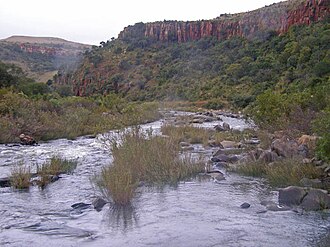
The Komati River rises in Mpumalanga, flows into Eswatini, returns to South Africa and then joins the Crocodile River before crossing into Mozambique, where the combined system is known as the Incomati and reaches the sea near Maputo. Its tributaries include the Mlumati. Few rivers illustrate more clearly that water does not respect political boundaries. Every decision about how much water is stored, released or used upstream affects the people downstream.
That is why South Africa and Eswatini signed the original Komati treaty in 1992, alongside a separate agreement creating a Joint Water Commission to advise both governments on technical matters. The following year, the two countries established the Komati Basin Water Authority, known as KOBWA, a bi-national body tasked with raising finance, designing and building the dams of the Komati River Basin Development Project, and then operating and maintaining them.
Two dams, one shared system
The first phase of that project produced two dams. Driekoppies Dam, in South Africa, is used only by South Africa and supports communities, agriculture and water supply in the Nkomazi area of Mpumalanga. Maguga Dam, in Eswatini, is shared between the two countries, with South Africa entitled to 60 percent of its water and Eswatini to 40 percent. The 1992 treaty set out how water would be allocated between the two countries and how the costs of building and running the dams would be shared.
By most accounts, the arrangement has worked. The dams were built, the authority has operated them for decades, and the two countries have managed to share water through droughts and floods without serious conflict. In a region where transboundary water disputes are often predicted, the Komati is a quiet success.
Why the treaty needed revising
After 33 years, however, the treaty was out of date. Both countries have changed their water laws since 1992, KOBWA’s operating environment has changed, and international principles on transboundary water cooperation have developed. Public consultations were held in both countries, and each followed its own formal process for approving treaties before the signing.
The revised treaty broadens KOBWA’s mandate. Under the original agreement, its role was tied closely to the first phase of the project. The new text allows it to help improve water services for citizens of both countries and to pursue sustainable revenue to cover its operating costs. According to the department, the aim is to make KOBWA financially self-sustaining and less dependent on contributions from the two governments, and to make it possible to plan a second phase of development, including possible new dam projects. Department spokesperson Wisane Mavasa described the revision as a new chapter in managing the basin’s water sustainably.
Keeping Mozambique in the picture
The ministers also turned their attention downstream. Under the broader Incomati and Maputo watercourse agreement between South Africa, Eswatini and Mozambique, a minimum flow must reach Mozambique, measured at the Ressano Garcia gauging station. The ministers stressed the importance of meeting the minimum cross-border flow of 2.6 cubic metres per second and asked KOBWA and the Inkomati-Usuthu Catchment Management Agency to work towards it.
They also committed their support to the Incomati-Maputo Water Commission, a new institution bringing together all three countries to cooperate on the development, protection and sustainable use of their shared rivers. The Joint Water Commission will meet at least once a year, and the ministers will hold regular discussions on progress.
Why it matters
South Africa depends heavily on shared rivers. The Lesotho Highlands Water Project, which supplies much of Gauteng’s water, is built on a treaty with Lesotho. The Limpopo and Orange rivers are shared with several neighbours. As climate change makes rainfall less predictable and demand continues to grow, the ability to cooperate across borders will become even more important.
The Komati treaty is a reminder that such cooperation is possible and can be durable. It also offers a contrast with the problems that dominate much of South Africa’s water news. Here, institutions were set up with clear mandates, infrastructure was built and maintained, and two governments took the time to review and modernise an agreement rather than letting it fall into neglect. If the revised treaty leads to a well-run second phase and reliable flows to Mozambique, it will strengthen water security for communities on all sides of the border.
References
SAnews: South Africa and Eswatini sign revised Komati River Basin treaty (16 March 2026): https://www.sanews.gov.za/node/80227
SAnews: SA, Eswatini to sign revised Komati Basin water treaty (March 2026): https://www.sanews.gov.za/node/80159
Polity: South Africa, Eswatini ink revised Komati River Basin treaty (13 March 2026): https://polity.org.za/article/south-africa-eswatini-ink-revised-komati-river-basin-treaty-2026-03-13
Citizen (Mpumalanga News): Ministers sign revised water usage treaty of Eswatini and Mpumalanga’s water basin (21 March 2026): https://www.citizen.co.za/mpumalanga-news/news-headlines/local-news/2026/03/21/ministers-sign-revised-water-usage-treaty-of-eswatini-mpumalangas-water-basin/
Department of Water and Sanitation: Articles 2025, including the Driekoppies water treatment works project: https://www.dws.gov.za/Archives/Articles2025.aspx