
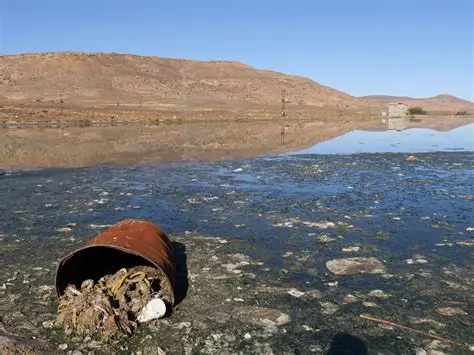
The first full Green Drop report since 2022 shows wastewater treatment getting worse across almost every province, with the share of critical systems rising from 39 to 47 percent. Only 14 systems in the country earned certification.
On Tuesday 31 March 2026, Minister of Water and Sanitation Pemmy Majodina released the 2025 Green Drop report, the government’s official assessment of how municipalities manage wastewater. It was released alongside progress reports on the Blue Drop programme, which covers drinking water quality, and the No Drop programme, which deals with water losses. Taken together, they offer the most detailed official picture of the state of the country’s water and sanitation systems in several years. The headline message is stark: South Africa’s sewage treatment is deteriorating at an alarming pace.
The numbers
The Green Drop assessment covered 848 municipal wastewater treatment systems for the 2023/24 financial year. Systems scoring below 31 percent are classified as being in a critical state. In the previous full report, in 2022, 39 percent of systems fell into that category. In 2025 the figure rose to 47 percent, meaning that nearly half of the country’s wastewater systems are now failing badly.
At the other end of the scale, the share of systems rated excellent or good fell from 14 percent to 8 percent. Only 14 systems achieved full Green Drop certification, down from 22 in 2022. The department also introduced stricter disqualifiers, so that systems producing non-compliant effluent can no longer score well simply by having their paperwork in order.
Province by province
The decline was widespread. The Northern Cape was the worst performer, with 65 of its 78 systems, or 86 percent, in a critical state. In the Free State, 81 of 96 systems were critical. The Eastern Cape’s share of critical systems rose from 39 to 54 percent, KwaZulu-Natal’s from 14 to 41 percent, and Gauteng’s from 15 to 38 percent. Even the Western Cape, traditionally the best performer, regressed, largely because of the new effluent and sludge disqualifiers.
There were some bright spots. Limpopo and Mpumalanga improved, and the minister singled out smaller municipalities in Mpumalanga for credit. Their progress shows that improvement is possible even with limited resources.
Why the systems are failing
The department and the minister pointed to a familiar set of causes: inadequate maintenance, ageing infrastructure, unstable governance, insufficient investment and a severe shortage of skilled staff. The shortfall in trained process controllers, the people who actually run treatment works, stands at 68 percent in the Free State, 82 percent in the Northern Cape and 59 percent in Limpopo. In KwaZulu-Natal, some works are being overwhelmed by industrial effluent they were never designed to treat. The minister also cited vandalism, illegal connections, corruption and criminal activity targeting infrastructure.
A key structural problem is money. National government cannot compel municipalities to spend the revenue they collect from water and sanitation on operating and maintaining those services. In many municipalities, that money is used for other purposes, leaving treatment works without the chemicals, spare parts and staff they need. The department sees the Water Services Amendment Bill, now before Parliament, as the way to close that gap, including through possible personal liability for accounting officers.
Drinking water and water losses
The Blue Drop progress assessment offered more mixed news. The share of drinking water systems at critical risk fell slightly, from 10 to 8 percent, and 622 systems were rated low risk. Drinking water in the major metros is generally performing well. The Western Cape had 93 percent of its systems at low risk and none at critical risk. The full Blue Drop and No Drop reports, which will verify these progress results, are due in 2027.
The No Drop progress report showed little change on water losses. Nationally, non-revenue water, the share of water lost to leaks, theft or unbilled use, stands at about 47.3 percent, essentially unchanged since 2013. Gauteng alone loses an estimated 431 billion litres a year this way, roughly equal to the entire annual supply of the Western Cape.
What happens next
The department has outlined several next steps, including a special report on sewer networks and pump stations, provincial interventions in KwaZulu-Natal, the Free State and North West, and closer work with the National Prosecuting Authority on pollution cases, including the possibility of specialised courts. It also plans to audit 2024/25 data in the next reporting cycle, which matters because the current report reflects conditions two years ago, and in some municipalities things may have worsened since.
The Green Drop report is not just a regulatory document. Every critical system represents a stream of poorly treated sewage flowing into a river, and often into the water source for the next town downstream. For the rivers the MAP Forum watches, including the Apies, the Pienaars and the Hennops, the findings confirm what citizen monitors have been seeing. The question now is whether the report, and the reforms it is meant to support, can reverse a decline that has been building for more than a decade.
References
Engineering News: Latest Drop reports show more deterioration of South Africa’s wastewater systems (1 April 2026): https://www.engineeringnews.co.za/article/new-drop-reports-shows-more-deterioration-of-south-africas-wastewater-systems-2026-04-01
SAnews: Majodina calls for accountability and collective action to protect water resources (1 April 2026): https://www.sanews.gov.za/node/80576
Department of Water and Sanitation: Media advisory on the release of the Green Drop report (26 March 2026): https://www.dws.gov.za/Communications/MediaAdvisory/2026/MA%20-%20Minister%20Majodina%20to%20Release%20Green%20Drop%20Report%20and%20Progress%20Updates%20on%20Blue%20and%20No%20Drop%20Programmes.pdf
Parliamentary Monitoring Group: Green, Blue and No Drop Reports 2025, ministry briefing: https://pmg.org.za/committee-meeting/43264/
Department of Water and Sanitation: 2025 Green Drop and Blue and No Drop progress reports, overall findings: https://static.pmg.org.za/260609_GD_BD_ND_overall_findings_PC_9_June_26.pdf