
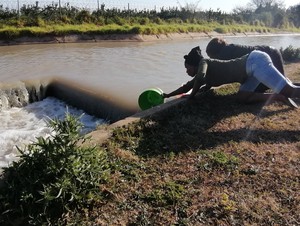
New testing shows that two thirds of the Gauteng water sources sampled are unsafe, with sewage, waste and algae choking the Jukskei, Klip, Hennops and the Vaal. Government is turning to criminal charges and a polluter-pays levy, but the rivers are running out of time.
For people who live alongside Gauteng’s rivers, the evidence of pollution is not abstract. It is the smell of the Jukskei as it flows through Alexandra, the foam on the Klip River downstream of Johannesburg’s southern sewage works, and the thick mats of floating weed spreading across the Vaal. This month, a series of reports drew those observations together into a single, troubling picture: Gauteng’s rivers have become an environmental and public health crisis.
Two thirds of sources unsafe
The clearest data comes from WaterCAN, the citizen science initiative of the Organisation Undoing Tax Abuse. In a report released in December 2025, it tested 59 water sources across Gauteng and found 39 of them, about two thirds, unsafe for human consumption. Of 23 river samples analysed for bacteria, 21 had unsafe levels of coliform bacteria and 18 had unsafe levels of E. coli, the bacterium that indicates faecal contamination. All five dam samples failed on both measures.
The rivers most affected include the Jukskei, the Klip and the Hennops, along with parts of the Vaal system that supply much of the province’s drinking water. Pollutants range from raw sewage and solid waste to heavy metals and industrial chemicals. Monitoring on the Klip River has found not only E. coli above acceptable levels but also endosulfan, a pesticide.
The sewage works at the heart of it
Much of this pollution comes from the treatment works that are supposed to prevent it. The Department of Water and Sanitation has identified four Gauteng municipalities, Merafong City, Rand West City, Mogale City and Lesedi, whose wastewater systems are performing below the minimum threshold of 31 percent, and has laid criminal charges against all four.
In Johannesburg, the Goudkoppies wastewater treatment works in the south of the city has been discharging poorly treated effluent into the catchment that feeds the Klip River, causing the river to foam in places. Despite directives from the department, the works has not met acceptable effluent standards, and the department says it has finalised a criminal docket for the National Prosecuting Authority. Goudkoppies was also flagged by the Auditor-General in November 2025 as a material irregularity, with rusted pipes, cracked concrete and ineffective treatment processes.
The Vaal is turning green
Water management expert Anthony Turton has warned that Gauteng is facing a systemic failure in its water sector, concentrated in the four metros. He is particularly concerned about the Vaal, which is deteriorating quickly because of eutrophication. Excess nutrients from sewage and fertiliser feed cyanobacteria, also known as blue-green algae, which can release toxins harmful to people and livestock.
Turton also points to the rapid spread of water lettuce, an invasive floating plant, across the Vaal. He notes that the Vaal has reached levels of floating vegetation in about a decade that took roughly 70 years to develop at Hartbeespoort Dam, itself a notorious example of a polluted reservoir. He stresses that Rand Water’s treated drinking water still meets the national SANS 241 standard, but the cost and difficulty of treating ever more polluted raw water keeps rising.
Turton argues that South Africa’s water law already requires degraded rivers to be rehabilitated, but that this obligation has never actually been applied to any distressed river in the country.
Living with polluted rivers
The human cost is borne mostly by those with the fewest alternatives. Thousands of people live alongside increasingly contaminated waterways and use them for washing, fishing, religious practice and recreation. In Alexandra, recyclers work in the Jukskei, collecting plastic from water that smells of sewage and becomes dangerous after rain.
Tarryn Johnston, founder of the Hennops River Revival initiative, describes many of the province’s rivers as overwhelmed by the rate at which sewage enters them, turning them into rivers of disease. Her organisation has spent years removing waste from the Hennops, which flows through Tembisa, Centurion and towards Hartbeespoort, and she says getting municipalities to act has been extremely difficult.
Making polluters pay
Government is trying some new tools. The Department of Water and Sanitation’s Waste Mitigation Charge applies the polluter-pays principle to mines, factories and underperforming municipal treatment works. It is being piloted in the Jukskei, Hennops and Wonderfonteinspruit catchments, with plans to extend it to the Vaal system and Hartbeespoort Dam. Revenue from the charge is meant to be ring-fenced for water rehabilitation rather than absorbed into general budgets.
Responsibility for rivers, however, is spread thinly. Local government runs wastewater works and enforces by-laws on dumping and industrial effluent. Provinces investigate complaints and issue environmental directives. National government regulates treatment works and river discharges. Gauteng’s MEC for Environment, Ewan Botha, has said that river rehabilitation is mainly a municipal and national responsibility, with the province supporting through coordination and clean-up programmes.
What needs to happen
WaterCAN’s recommendations are practical: investigate and stop the sources of pollution, publish regular and transparent water quality results, provide emergency clean water in high-risk areas, and run awareness campaigns so communities know when water is unsafe and how to report contamination.
The tools exist. What has been missing is consistent enforcement and money that reaches the treatment works. Criminal charges against municipalities and a ring-fenced polluter-pays charge are steps in the right direction, but they will only matter if they lead to repaired works and cleaner discharges. Until then, the rivers that once defined Gauteng’s landscape will continue to carry the province’s failures downstream, to the Vaal, to Hartbeespoort, and to the people who depend on them.
References
GroundUp: Pollution is killing Gauteng’s fresh water sources (March 2026): https://groundup.news/article/pollution-is-killing-gautengs-fresh-water-sources/
Daily Maverick: Sewage, waste and failing infrastructure push Gauteng’s rivers toward ecological crisis (10 March 2026): https://www.dailymaverick.co.za/article/2026-03-10-sewage-waste-and-failing-infrastructure-e-push-gautengs-rivers-toward-ecological/
AllAfrica: Pollution is killing Gauteng’s fresh water sources (11 March 2026): https://allafrica.com/stories/202603110063.html
Bizcommunity: Pollution is killing Gauteng’s fresh water sources: https://www.bizcommunity.com/article/pollution-is-killing-gautengs-fresh-water-sources-955674a
Daily Maverick: R4bn diverted from Joburg Water, Auditor-General says cash exists on paper (19 November 2025): https://www.dailymaverick.co.za/article/2025-11-19-r4bn-diverted-from-joburg-water-auditorgeneral-says-cash-exists-on-paper/