
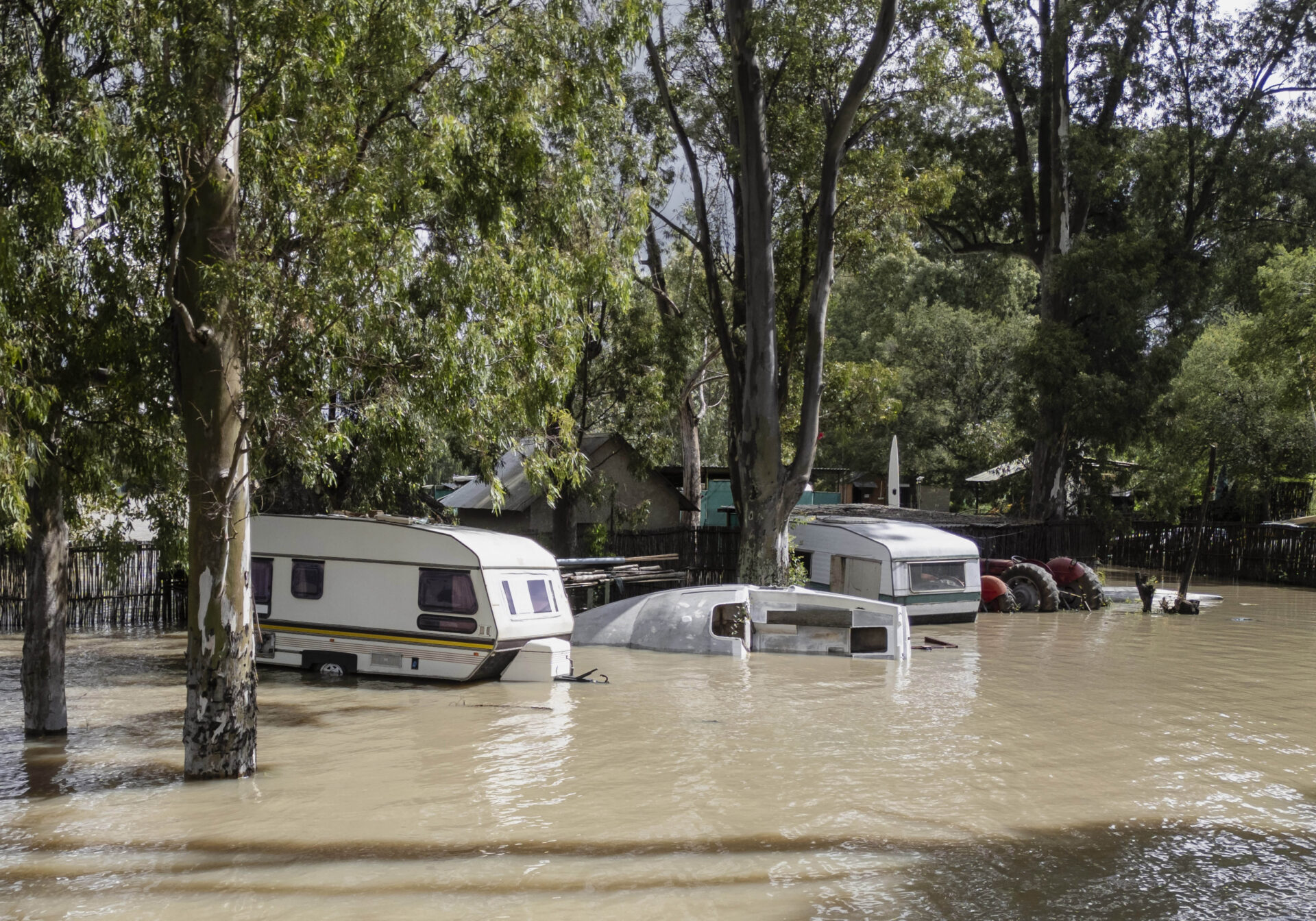
In the last fortnight of November, the Vaal Dam overflowed while parts of Johannesburg still relied on tankers. The contrast shows that Gauteng’s crisis is about delivery, not supply.
For much of the past two weeks, the Department of Water and Sanitation has been fighting too much water. Heavy rain across Gauteng and Mpumalanga pushed the Vaal Dam well past full capacity, and engineers opened sluice gate after sluice gate to release water safely downstream. Less than an hour’s drive to the north, in a city that depends on that same dam, some residents were still filling buckets from water tankers. It is hard to imagine a clearer illustration of what is really wrong with water in Gauteng.
A fortnight of sluice gates
The first gates opened on Monday 17 November, when the department opened five sluice gates at the Vaal Dam after heavy rainfall, sharply increasing releases from the dam. The following day three more gates were opened, bringing the total to eight, with the dam recorded at just over 109 percent of its full supply capacity and Bloemhof Dam, further downstream, close to full.
As inflows eased over the weekend of 22 and 23 November, the department began closing gates again, and by early in the week only three remained open. Then the rain returned. On 26 November four gates were reopened, raising outflows from about 325 to about 950 cubic metres per second. On 27 November three more followed, bringing the total to ten. By Friday 28 November the Vaal Dam stood at about 106.8 percent, with roughly 1,327 cubic metres per second flowing in and about 1,359 cubic metres per second being released. At Bloemhof, releases through the radial gates were increased to about 1,200 cubic metres per second.
The department stressed that opening sluice gates is a standard dam safety procedure, used when water levels rise sharply to protect the structure and the people living below it. It repeatedly warned that river banks downstream could overflow, and that infrastructure built in low-lying areas of the floodplain could be affected. Communities along the Vaal, from the Barrage to Parys and beyond, were urged to stay away from the river and to move property out of harm’s way.
Meanwhile, in Johannesburg
The floods arrived at the end of a month in which Johannesburg’s water troubles had become a national and international story. On 1 November, hundreds of residents gathered outside the Johannesburg Council Chambers in Braamfontein to protest against the water crisis, organised by a coalition of civil society groups that included WaterCAN, the Joburg Community Action Network and the Ahmed Kathrada Foundation. Organisers described it as a human rights and economic emergency.
Three weeks later, the G20 Leaders’ Summit was held at Nasrec on 22 and 23 November, the first time the summit had taken place on African soil. In the run-up, Gauteng Premier Panyaza Lesufi promised that there would be no water or electricity shortages during the summit, saying Johannesburg Water had given assurances that supply would remain secure. The utility had earlier said it had no planned supply disruptions for the two weeks before and during the event, with tankers on standby for key areas.
On 21 November, the day before world leaders arrived, the South African Human Rights Commission issued a statement on the water crisis in Gauteng. It said it had engaged Johannesburg Water between September and early October and the Gauteng Premier’s office on several occasions in September. Supply had since been restored to Selby in mid-October and to Sophiatown and Coronationville at the end of October, with tankers used in the meantime. The commission called on all stakeholders to act with urgency.
Supply is not delivery
The events of late November make a simple but important point. Gauteng’s bulk water resources are, for now, in good shape. The Vaal Dam, supported by transfers from the Lesotho Highlands Water Project, is full and spilling. The problem is what happens between the dam and the tap.
Rand Water treats and pumps bulk water to the metros. The metros, through utilities such as Johannesburg Water, are then responsible for storing it in reservoirs and towers and moving it through thousands of kilometres of pipes to homes and businesses. It is in that second step that the system is failing. A briefing to Parliament earlier in November heard that burst pipes in Johannesburg rose from about 20,700 in 2023/24 to more than 33,400 in 2024/25, and that the city loses roughly a third of the water it receives through leaks, illegal connections and metering failures. Reservoirs that cannot be filled fast enough, pump stations hit by power failures and maintenance backlogs all mean that a full dam far away does little for a household in Coronationville or Westbury.
This also explains why water restrictions and conservation campaigns can make sense even in a wet year. When a distribution network is leaking heavily and its storage is stretched, high demand on hot days can drain reservoirs faster than they can be refilled, leaving higher-lying areas dry even when bulk supply is abundant.
Floods and pollution
There is another, less visible side to heavy rain. Many of Gauteng’s sewer networks and wastewater treatment works are already operating beyond their design capacity. When stormwater gets into old and broken sewers, as it inevitably does during prolonged rain, it can overwhelm pump stations and treatment works, sending untreated or partially treated sewage into rivers. Floodwater also washes litter, chemicals and waste from informal dumping sites into streams.
The Vaal has long carried that burden, particularly from Emfuleni, whose collapsing sewage system has polluted the river for years. Only days before the sluice gates opened, the department launched a new ring-fenced utility, the Vaal Corporation Water Utility, to take over Emfuleni’s water and sanitation services. High flows can dilute pollution in the short term, but they also spread it further downstream and over floodplains, and they put extra pressure on precisely the infrastructure that the new utility has been asked to repair.
What the rain buys, and what it does not
Full dams buy Gauteng breathing space. They reduce the risk of bulk supply restrictions in the coming dry season and give planners some room while long-term projects, including the delayed second phase of the Lesotho Highlands Water Project, move forward. That is genuinely good news.
But the rain cannot fix a burst main, refill a reservoir that the network cannot reach, or repair a sewage pump station that has been neglected for years. Those problems depend on money, maintenance and management, the very issues that dominated the political debate in November, from the protest outside the council chambers to the questions in Parliament about R4 billion owed to Johannesburg Water. As the floodwaters move down the Vaal towards the Orange River, the real test for Gauteng’s municipalities will be whether they use this wet season to repair the systems that keep failing their residents, or whether they wait for the next dry spell to expose them all over again.
References
Polity: DWS to open five sluice gates at Vaal Dam (17 November 2025): https://www.polity.org.za/article/dws-to-open-five-sluice-gates-at-vaal-dam-2025-11-17
Engineering News: Three more sluice gates opened at Vaal Dam (18 November 2025): https://www.engineeringnews.co.za/article/three-more-sluice-gates-opened-at-vaal-dam-2025-11-18
Department of Water and Sanitation: DWS reopens four sluice gates at Vaal Dam to manage water outflow (26 November 2025): https://www.dws.gov.za/Communications/PressReleases/2025/MS%20-%20DWS%20reopens%20four%20(4)%20sluice%20gates%20at%20Vaal%20Dam%20to%20manage%20water%20outflow.pdf
SAnews: Three additional sluice gates opened at Vaal Dam (27 November 2025): https://www.sanews.gov.za/node/78518
SAnews: Vaal Dam gates remain fully open as levels rise (28 November 2025): https://www.sanews.gov.za/node/78534
EWN: Water and Sanitation issues warning as 10 Vaal Dam sluice gates open (29 November 2025): https://www.ewn.co.za/2025/11/29/water-sanitation-issues-warning-as-10-vaal-dam-sluice-gates-open
GroundUp via AllAfrica: Joburg protesters call for end to water crisis (3 November 2025): https://allafrica.com/stories/202511040038.html
IOL: Lesufi on water and electricity supply during the G20 summit (5 November 2025): https://iol.co.za/news/politics/2025-11-05-lesufi-there-will-be-no-uninterrupted-water-and-electricity-supply-during-g20-summit/
South African Human Rights Commission: Media statement on the water crisis in Gauteng (21 November 2025): https://sahrc.org.za/index.php/sahrc-media/news-2/item/4410-media-statement-the-water-crisis-in-gauteng-and-the-south-african-human-rights-commission-s-interventions-toward-immediate-and-long-term-redress