
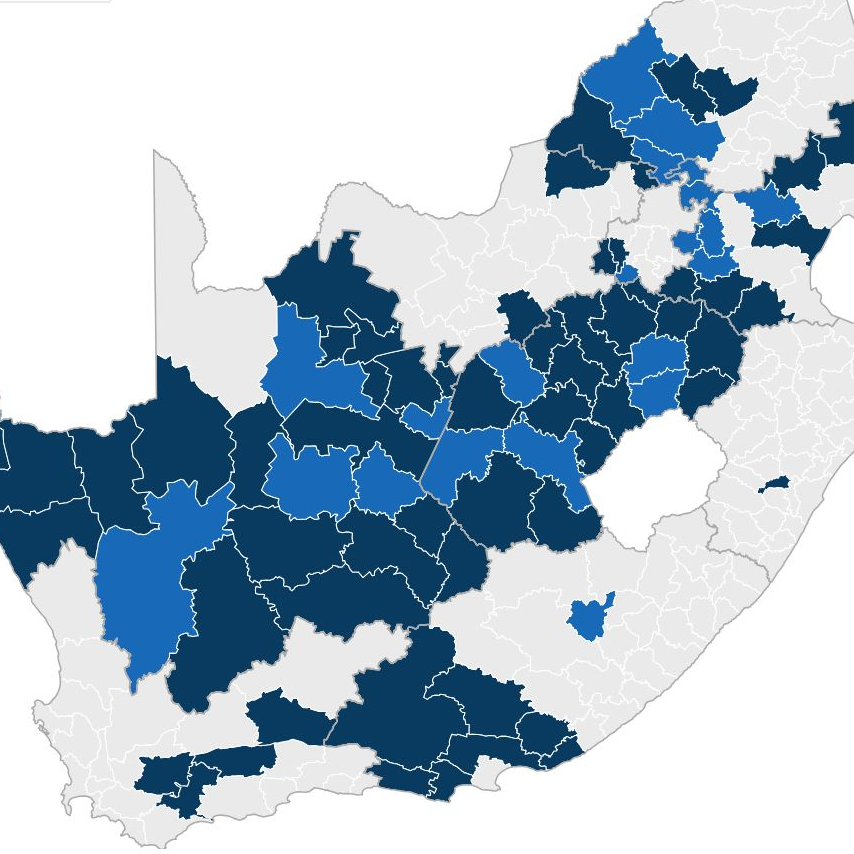
Municipalities now owe the country’s water boards more than R27 billion, R23 billion of it overdue. The department’s budget for 2026/27 shows how that debt, and a shrinking budget, shape what can be built.
When a household does not pay its water bill, the municipality can cut it off. When a municipality does not pay its bulk water supplier, the consequences ripple across entire regions. That is the problem at the centre of the Department of Water and Sanitation’s 2026/27 budget, presented to Parliament in May and unpacked further by Minister Pemmy Majodina in June. As of 31 March 2026, municipalities owed the country’s water boards more than R27 billion, of which R23 billion was overdue. The minister said the situation was worse than in mid-2025.
How the debt spiral works
Water boards such as Rand Water, Magalies Water and Umgeni-uThukela Water treat raw water and sell it in bulk to municipalities, which distribute it to homes and businesses and bill them. When municipalities fail to collect from residents, lose water through leaks, or use their water revenue for other purposes, they fall behind on their payments to the boards. The boards, in turn, struggle to fund their own operations, maintenance and expansion.
The boards have responded in the ways available to them. Some have throttled supply to defaulting municipalities. In extreme cases, they have attached municipal bank accounts. National Treasury has also acted, withholding equitable share allocations, the national transfers municipalities rely on, from 62 of the worst non-paying municipalities. In May, Rand Water’s chief executive told the Human Rights Commission that municipalities owe his utility alone about R9 billion, with Emfuleni accounting for close to R1.9 billion.
Each of these measures puts pressure on municipalities to pay, but each also risks hurting residents, who are rarely the cause of the problem.
A smaller budget
The department’s overall budget falls from about R23.4 billion in 2025/26 to about R22 billion in the current cycle. Within that, R12.3 billion has been allocated to infrastructure grants. The Regional Bulk Infrastructure Grant funds 70 bulk water projects in all nine provinces, and the Water Services Infrastructure Grant supports 341 projects, 175 of which are due to be completed this financial year.
The department plans to intensify its support and interventions in the 107 worst-performing municipalities, identified through the Blue Drop and Green Drop assessments. It also wants to use its grants to leverage private sector and development finance, with water boards and the Development Bank of Southern Africa implementing projects on behalf of struggling municipalities. The President discussed a National Water Action Plan with mayors on 30 April, focusing on service delivery reforms, financial sustainability and staff competence.
The good news in the budget
The budget also recorded real progress. Among projects completed in 2025/26 was the R759 million expansion of the Klipdrift water treatment works serving Hammanskraal, which the minister said is now producing its full 50 megalitres a day. It is a milestone for a community whose struggle for clean water became a national symbol after the 2023 cholera outbreak.
Other completed projects included the first phase of the Giyani Water Project in Limpopo, at R4.8 billion, which has so far reticulated 24 of 55 villages, the R736 million Babanana bulk pipeline in Limpopo, the R1.5 billion third phase of the Maphumulo bulk scheme in KwaZulu-Natal and the R351 million Moretele South scheme in North West. Planned for 2026/27 are four bulk schemes in the Chris Hani District worth R2.24 billion, the R2 billion Loskop regional bulk scheme in Mpumalanga, the R1.1 billion George water supply project in the Western Cape and more than R2.3 billion of schemes in North West.
Taps without water
The minister summed up the central challenge herself. She said that while most South Africans now have access to a tap, water often does not come out of it or is not safe to drink, and that the reliability of municipal water services has declined sharply. Bulk projects can bring water to a municipality’s doorstep, but they cannot fix the leaking pipes, broken pumps and unpaid bills that stop it reaching homes.
Breaking the cycle
The debt crisis is a symptom of the same failures the Auditor-General and the Green Drop reports have identified: poor revenue collection, high water losses, diverted revenue and weak financial management. The long-term answer lies in ring-fencing water revenue so that it is used to pay for water, reducing non-revenue water so that more of what is bought can be billed, and building capable water service providers, the core aims of the Water Services Amendment Bill.
Until then, the R27 billion owed to water boards will keep growing, and the boards that keep the country’s bulk water flowing will remain under strain. The completed projects show that investment can deliver. The debt shows how easily that progress can be undermined if the money stops flowing back.
References
SAnews: R12bn allocated to water infrastructure grants (17 May 2026): https://www.sanews.gov.za/node/81458
Department of Water and Sanitation: Minister Majodina to unpack 2026/27 Budget Vote and water sector priorities (16 June 2026): https://www.dws.gov.za/Communications/MediaAdvisory/2026/MA%20-%20Minister%20Majodina%20to%20unpack%202026_27%20Budget%20Vote%20and%20water%20sector%20priorities.pdf
TimesLIVE: Armed gangs, ageing pipes and tanker costs strain Joburg water system, commission hears (21 May 2026): https://www.timeslive.co.za/news/south-africa/2026-05-21-armed-gangs-ageing-pipes-and-tanker-costs-strain-joburg-water-system-commission-hears/
EWN: Municipal debt to water boards stands at R23.7bn and continues to grow (19 November 2024): https://www.ewn.co.za/2024/11/19/municipal-debt-to-water-boards-stands-at-r237bn-and-continues-to-grow-parliament-hears